


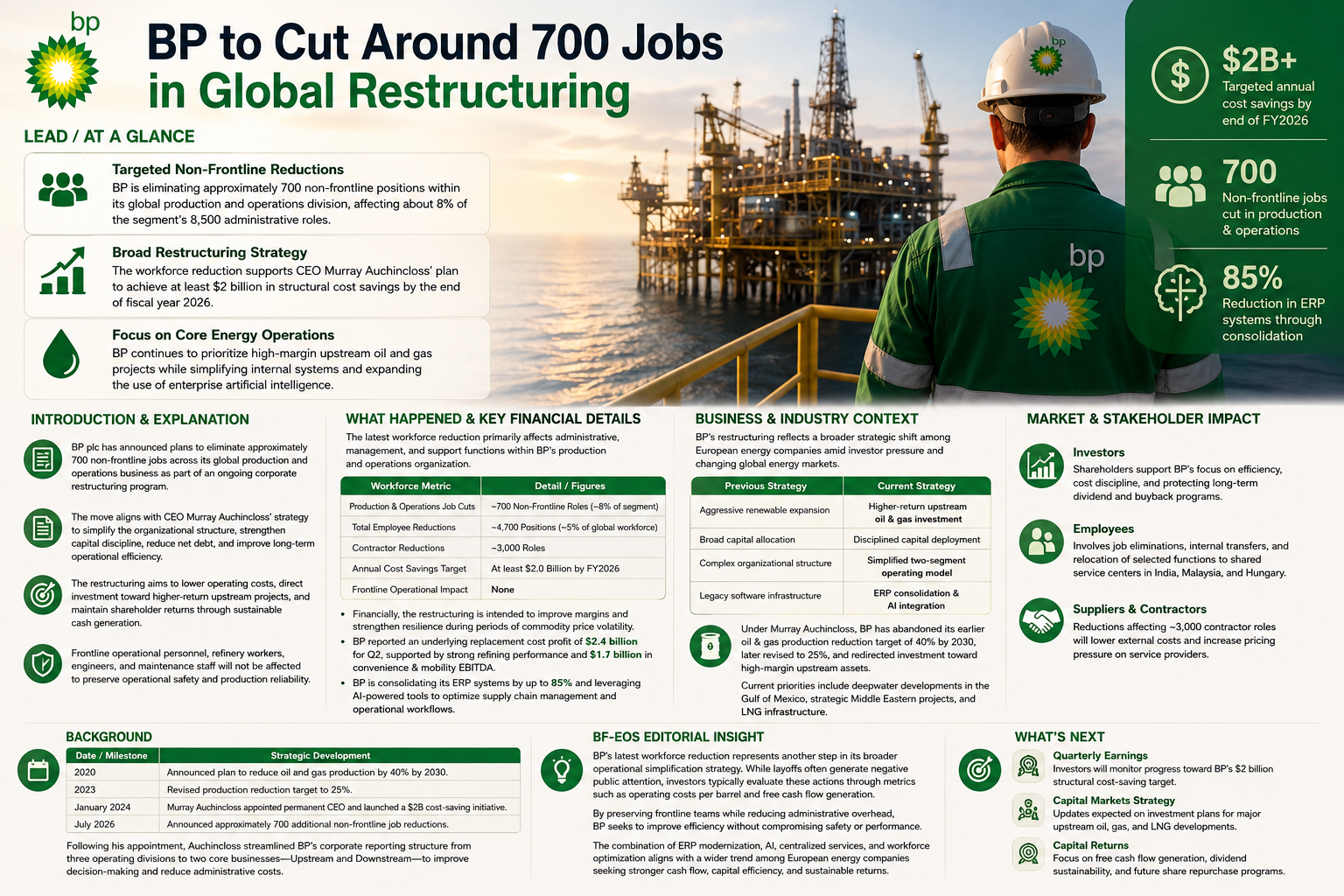
Lead / At a Glance
Targeted Non-Frontline Reductions
BP is eliminating approximately
700 non-frontline positions within its
global production and operations division, affecting about
8% of the segment’s 8,500 administrative
roles.
Broad Restructuring Strategy
The workforce reduction supports CEO
Murray Auchincloss’ plan to achieve at
least $2 billion in structural cost savings
by the end of fiscal year 2026.
Focus on Core Energy Operations
BP continues to prioritize high-margin upstream oil and gas
projects while simplifying internal systems and expanding
the use of enterprise artificial intelligence.
Introduction & Explanation
BP plc has announced plans to eliminate approximately
700 non-frontline jobs across its global
production and operations business as part of an ongoing corporate
restructuring program.
According to an internal memo reviewed by Reuters, the move aligns
with CEO Murray Auchincloss’ strategy to simplify the company’s
organizational structure, strengthen capital discipline, reduce net
debt, and improve long-term operational efficiency.
The restructuring forms part of a broader initiative aimed at
lowering operating costs, directing investment toward higher-return
upstream projects, and maintaining shareholder returns through
sustainable cash generation.
BP emphasized that frontline operational personnel, refinery
workers, engineers, and maintenance staff will not be affected in
order to preserve operational safety and production reliability.
What Happened & Key Financial Details
The latest workforce reduction primarily affects administrative,
management, and support functions within BP’s production and
operations organization.
| Workforce Metric | Detail / Figures |
|---|---|
| Production & Operations Job Cuts | ~700 Non-Frontline Roles (~8% of segment) |
| Total Employee Reductions | ~4,700 Positions (~5% of global workforce) |
| Contractor Reductions | ~3,000 Roles |
| Annual Cost Savings Target | At least $2.0 Billion by FY2026 |
| Frontline Operational Impact | None |
The 700-role reduction follows BP’s previously announced plan to
eliminate approximately
4,700 employee positions and
3,000 contractor roles globally.
Financially, the restructuring is intended to improve margins and
strengthen resilience during periods of commodity price volatility.
BP recently reported an underlying replacement cost profit of
$2.4 billion for the second quarter, supported by
strong refining performance and
$1.7 billion in convenience and mobility EBITDA.
As part of the efficiency program, BP is consolidating its
enterprise resource planning (ERP) systems by up to
85% while deploying AI-powered tools to optimize
supply chain management and operational workflows.
Business & Industry Context
BP’s restructuring reflects a broader strategic shift among European
energy companies as they reassess capital allocation priorities in
response to investor pressure and changing global energy markets.
| Previous Strategy | Current Strategy |
|---|---|
| Aggressive renewable expansion | Higher-return upstream oil & gas investment |
| Broad capital allocation | Disciplined capital deployment |
| Complex organizational structure | Simplified two-segment operating model |
| Legacy software infrastructure | ERP consolidation & AI integration |
Under Murray Auchincloss, BP has abandoned its earlier objective of
reducing oil and natural gas production by 40% by 2030, later
revised to 25%, and instead redirected investment toward
higher-margin upstream assets.
Current capital priorities include deepwater developments in the
Gulf of Mexico, strategic Middle Eastern projects, and liquefied
natural gas (LNG) infrastructure.
Market & Stakeholder Impact
-
Investors: Many institutional shareholders have
welcomed BP’s continued focus on operational efficiency, cost
discipline, and protecting long-term dividend and share buyback
programs. -
Employees: The restructuring includes job
eliminations, internal transfers, and the relocation of selected
engineering and administrative functions to lower-cost shared
service centers in India, Malaysia, and Hungary. -
Suppliers & Contractors: Planned reductions
affecting approximately 3,000 contractor roles are expected to
reduce external consulting expenses while increasing pricing
pressure on service providers.
Background
BP’s transformation has evolved through several strategic shifts
over recent years as the company balanced energy transition goals
with shareholder expectations.
| Date / Milestone | Strategic Development |
|---|---|
| 2020 | Announced plan to reduce oil and gas production by 40% by 2030. |
| 2023 | Revised production reduction target to 25%. |
| January 2024 | Murray Auchincloss appointed permanent CEO and launched a $2B cost-saving initiative. |
| July 2026 | Announced approximately 700 additional non-frontline job reductions. |
Following his appointment, Auchincloss streamlined BP’s corporate
reporting structure from three operating divisions to two core
businesses—Upstream and Downstream—to improve decision-making and
reduce administrative costs.
BF-EOS Editorial Insight
BP’s latest workforce reduction represents another step in its
broader operational simplification strategy. While layoffs often
generate negative public attention, investors typically evaluate
these actions through metrics such as operating costs per barrel and
free cash flow generation.
By preserving frontline operational teams while reducing
administrative overhead, BP seeks to improve organizational
efficiency without compromising safety or production performance.
The combination of ERP modernization, artificial intelligence,
centralized support services, and workforce optimization reflects a
wider trend among European energy companies seeking stronger cash
flow, improved capital efficiency, and more sustainable shareholder
returns.
What’s Next
-
Quarterly Earnings: Investors will monitor
progress toward BP’s
$2 billion structural cost-saving target. -
Capital Markets Strategy: Additional updates
are expected regarding investment plans for major upstream oil,
gas, and LNG developments. -
Capital Returns: Market participants will
continue evaluating BP’s free cash flow generation, dividend
sustainability, and future share repurchase programs.