

At a Glance
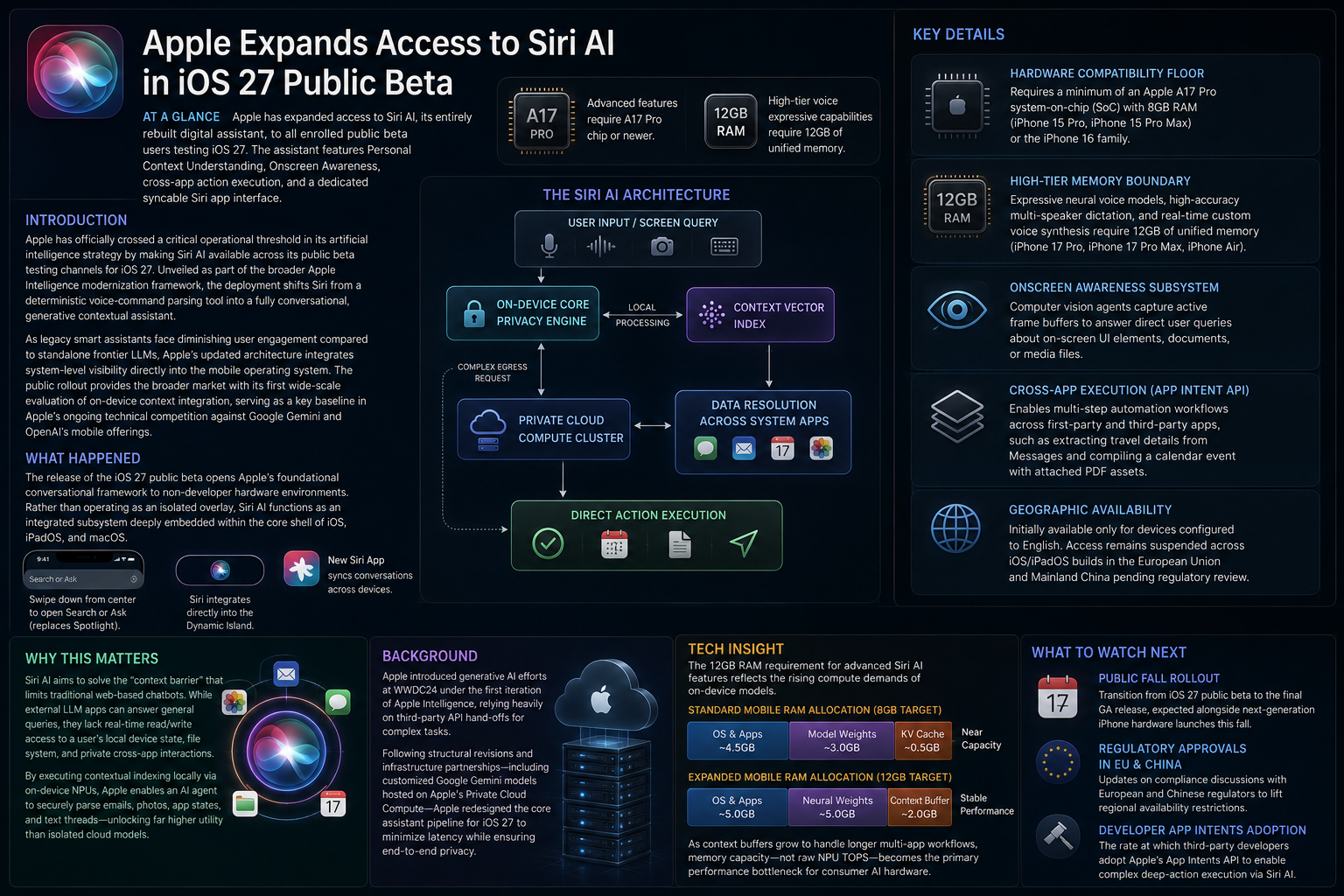
- Apple has expanded access to Siri AI, its entirely rebuilt digital assistant, to all enrolled public beta users testing iOS 27.
- The assistant features Personal Context Understanding, Onscreen Awareness, cross-app action execution, and a dedicated syncable Siri app interface.
- Advanced features require an A17 Pro chip or newer, while high-tier voice expressive capabilities mandate 12GB of unified memory.
Introduction
Apple has officially crossed a critical operational threshold in its artificial intelligence strategy by making Siri AI available across its public beta testing channels for iOS 27. Unveiled as part of the broader Apple Intelligence modernization framework, the deployment shifts Siri from a deterministic voice-command parsing tool into a fully conversational, generative contextual assistant.
As legacy smart assistants face diminishing user engagement compared to standalone frontier LLMs, Apple’s updated architecture integrates system-level visibility directly into the mobile operating system. The public rollout provides the broader market with its first wide-scale evaluation of on-device context integration, serving as a key baseline in Apple’s ongoing technical competition against Google Gemini and OpenAI’s mobile offerings.
What Happened
The release of the iOS 27 public beta opens Apple’s foundational conversational framework to non-developer hardware environments. Rather than operating as an isolated overlay, Siri AI functions as an integrated subsystem deeply embedded within the core shell of iOS, iPadOS, and macOS.
[ User Input / Screen Query ]
            │
            ▼
[ On-Device Core Privacy Engine ] ──(Local Processing)──> [ Context Vector Index ]
            │                                                      │
            ├───────(Complex Egress Request)────────┐              │
            ▼                                       ▼              ▼
[ Private Cloud Compute Cluster ] <──────> [ Data Resolution across System Apps ]
            │                                                      │
            └───────────────────────┬──────────────────────────────┘
                                    ▼
                         [ Direct Action Execution ]
System interaction pathways have been redesigned. Swiping down from the center of the home screen now initializes a Search or Ask unified prompt, replacing legacy Spotlight interactions, while the visual identity of the assistant integrates directly into the Dynamic Island interface. Furthermore, Apple has deployed a standalone Siri App that maintains cross-device thread history synced via end-to-end encrypted iCloud storage, enabling users to review, resume, or export previous computational sessions.
Key Details
The operational metrics, system dependencies, and deployment boundaries for the iOS 27 Siri AI rollout include:
- Hardware Compatibility Floor: Requires a minimum of an Apple A17 Pro system-on-chip (SoC) with 8GB RAM (iPhone 15 Pro, iPhone 15 Pro Max) or the iPhone 16 family.
- High-Tier Memory Boundary: Expressive neural voice models, high-accuracy multi-speaker dictation, and real-time custom voice synthesis require 12GB of unified memory (supported on iPhone 17 Pro, iPhone 17 Pro Max, and iPhone Air).
- Onscreen Awareness Subsystem: Computer vision agents capture active frame buffers to answer direct user queries regarding on-screen UI elements, documents, or media files.
- Cross-App Execution (App Intent API): Enables multi-step automation workflows across first-party and third-party applications, such as extracting travel details from Messages and compiling a calendar event with attached PDF assets.
- Geographic Availability: Initially available only for devices configured to English. Access remains suspended across iOS/iPadOS builds within the European Union and Mainland China pending regulatory review.
Why This Matters
For consumer technology markets, Siri AI represents a structural attempt to solve the “context barrier” that limits traditional web-based chatbots. While external LLM applications can answer general knowledge queries, they lack real-time read/write access to a user’s local device state, file system, and private cross-app interactions due to privacy sandboxing.
By executing contextual indexing locally via on-device neural processing units (NPUs), Apple allows an AI agent to parse emails, local photos, app states, and text threads securely. This approach aims to validate the hypothesis that a context-aware assistant embedded directly into an operating system offers higher utility than a more powerful, isolated cloud model.
Background
Apple originally introduced its foundational generative AI efforts at WWDC24 under the first iteration of Apple Intelligence. However, early builds relied heavily on third-party API hand-offs (such as external ChatGPT integrations) for complex reasoning tasks.
Following structural revisions to its software division and key infrastructure partnerships—including utilizing customized Google Gemini models hosted on Apple’s Private Cloud Compute (PCC) architecture—Apple redesigned the core assistant pipeline for iOS 27. This architectural overhaul focuses on minimizing cloud network latency while ensuring end-to-end user privacy compliance.
Tech Insight
The hardware restriction requiring 12GB of RAM for the most advanced Siri AI functions highlights the escalating compute demands of mobile on-device models. Operating large language and multimodal models directly on edge devices requires allocating significant memory for weight residency, key-value (KV) caching, and active context windows without forcing the operating system to purge background applications from system RAM.
Standard Mobile RAM Allocation (8GB Target):
[ OS Kernel & Apps: ~4.5GB ] + [ On-Device Model Weights: ~3.0GB ] + [ KV Cache: ~0.5GB ] ──> Near Capacity

Expanded Mobile RAM Allocation (12GB Target):
[ OS Kernel & Apps: ~5.0GB ] + [ Expanded Neural Weights: ~5.0GB ] + [ Dynamic Context Buffer: ~2.0GB ] ──> Stable
Apple’s multi-tiered hardware segmentation demonstrates that high-throughput, low-latency mobile generative AI requires continuous memory bandwidth expansion. As dynamic context buffers grow to process longer multi-app workflows, RAM capacity—rather than raw NPU TOPS (Trillions of Operations Per Second)—becomes the primary performance bottleneck for consumer AI hardware.
What to Watch Next
Developer App Intents Adoption: The rate at which third-party app developers update their software schemas using Apple’s new App Intents API to enable complex deep-action execution via Siri AI.
Public Fall Rollout: The transition from current iOS 27 public beta builds to the final general availability (GA) release expected alongside next-generation iPhone hardware launches this fall.
Regulatory Approvals in EU & China: Updates regarding compliance discussions with European Union digital market regulators and Chinese regulatory bodies to lift regional availability restrictions.